# Combo chart

{% hint style="info" %}
Availability:

* Summary view - All modes except for Transaction and Total.
* Focused view (when you select and focus on items in a dimension) - Variance and Stream mode only.
  {% endhint %}

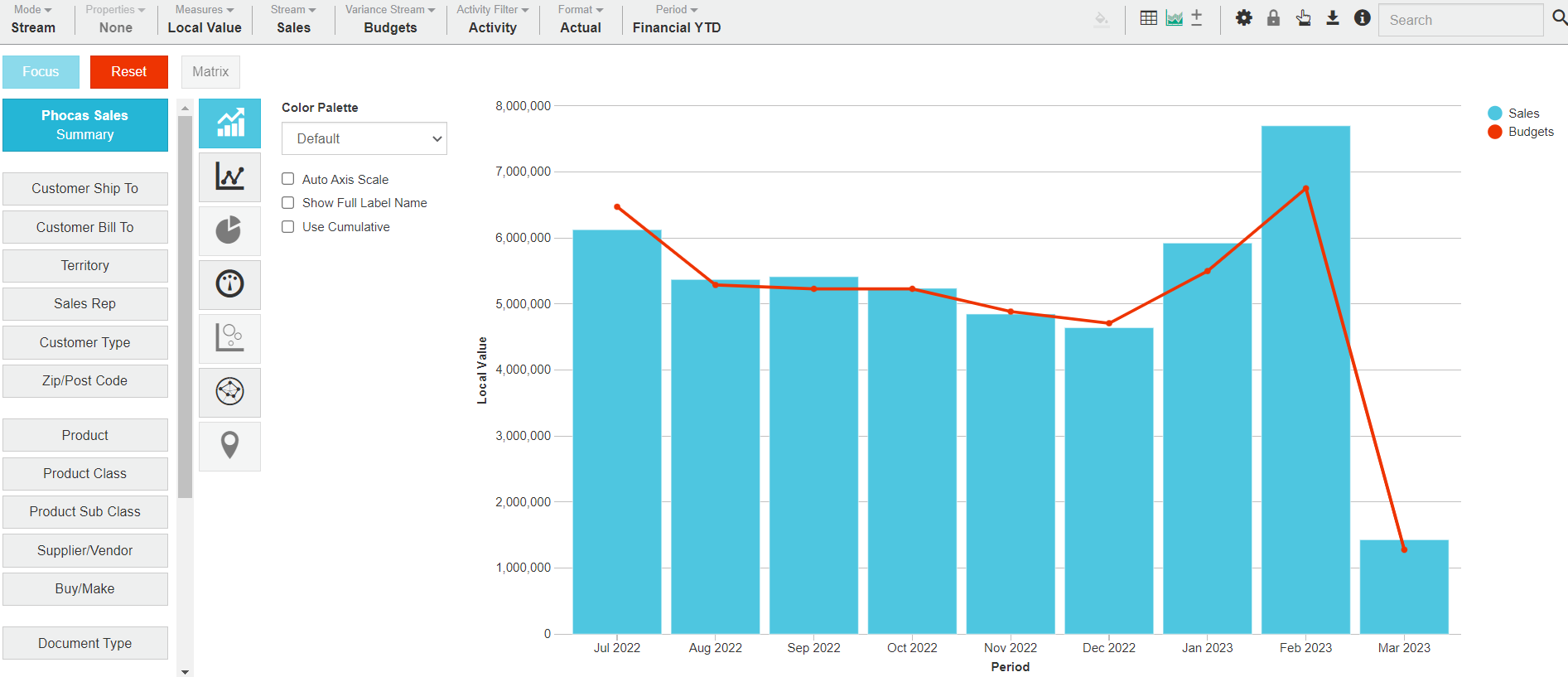
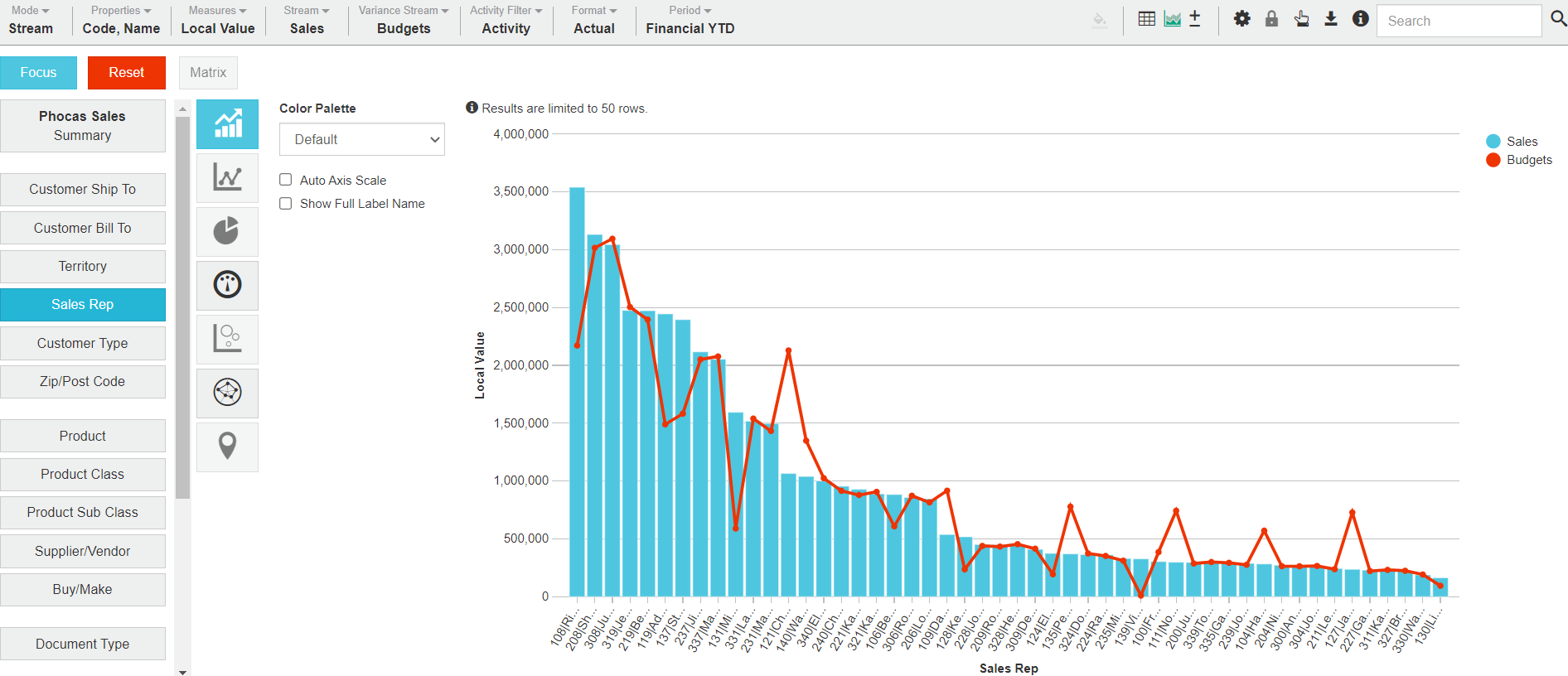
A Combo chart is a combination of the Column and Line charts. One data set, such as a period or stream, is represented by blue columns (bars) and the data set variable is represented by a set of red points connected by straight lines. The use of different elements (bar and line) makes it easier to visualize two distinct sets of data.

Combo charts are useful for simple comparisons involving more than one data set, such as different years. For example, you might want to compare sales against the budget or the performance of Sales Reps this calendar year to date (YTD) against last calendar YTD.&#x20;

The following table describes what the Combo chart looks like in each view.

<table data-header-hidden><thead><tr><th width="144"></th><th></th><th></th></tr></thead><tbody><tr><td></td><td><strong>Summary view</strong></td><td><strong>Focused view</strong></td></tr><tr><td><strong>Contents</strong></td><td>There is a blue column for the current period (or stream) and a red line for the previous period (or other stream).</td><td>There is a column/line for each of the focused items.</td></tr><tr><td><strong>X-axis</strong></td><td>The X-axis displays the time units of your current period. </td><td>The X-axis displays each focused item.</td></tr><tr><td><strong>Y-axis</strong></td><td>The Y-axis displays the total, which starts at zero.</td><td>The Y-axis displays the total, which starts at zero.</td></tr><tr><td><strong>Example</strong></td><td><img src="https://content.gitbook.com/content/itAvDF3MljQXV0rjHRP7/blobs/EMEryegrrryA3MVPTiy7/3017900293.png" alt="" data-size="original"></td><td><img src="https://content.gitbook.com/content/itAvDF3MljQXV0rjHRP7/blobs/UntpjKEBHMIXmrEW2Yke/3018064021.png" alt="" data-size="original"></td></tr></tbody></table>

<details>

<summary>Example: Create a Combo chart</summary>

{% hint style="success" %}
**Related pages**

You can take the following actions with your chart:&#x20;

[Configure the chart options](https://docs.phocassoftware.com/analytics/visualize-your-data-in-a-chart/configure-the-chart-options) | [Select and focus on a chart segment](https://docs.phocassoftware.com/analytics/visualize-your-data-in-a-chart/select-and-focus-on-a-chart-segment) | [Use the chart legend](https://docs.phocassoftware.com/analytics/visualize-your-data-in-a-chart/use-the-chart-legend) | Save the chart as a favorite | Add the chart to a dashboard | [Export a chart as an image](https://docs.phocassoftware.com/analytics/visualize-your-data-in-a-chart/export-a-chart-as-an-image)

See also the main page: [Visualize your data in a chart](https://docs.phocassoftware.com/analytics/visualize-your-data-in-a-chart)
{% endhint %}

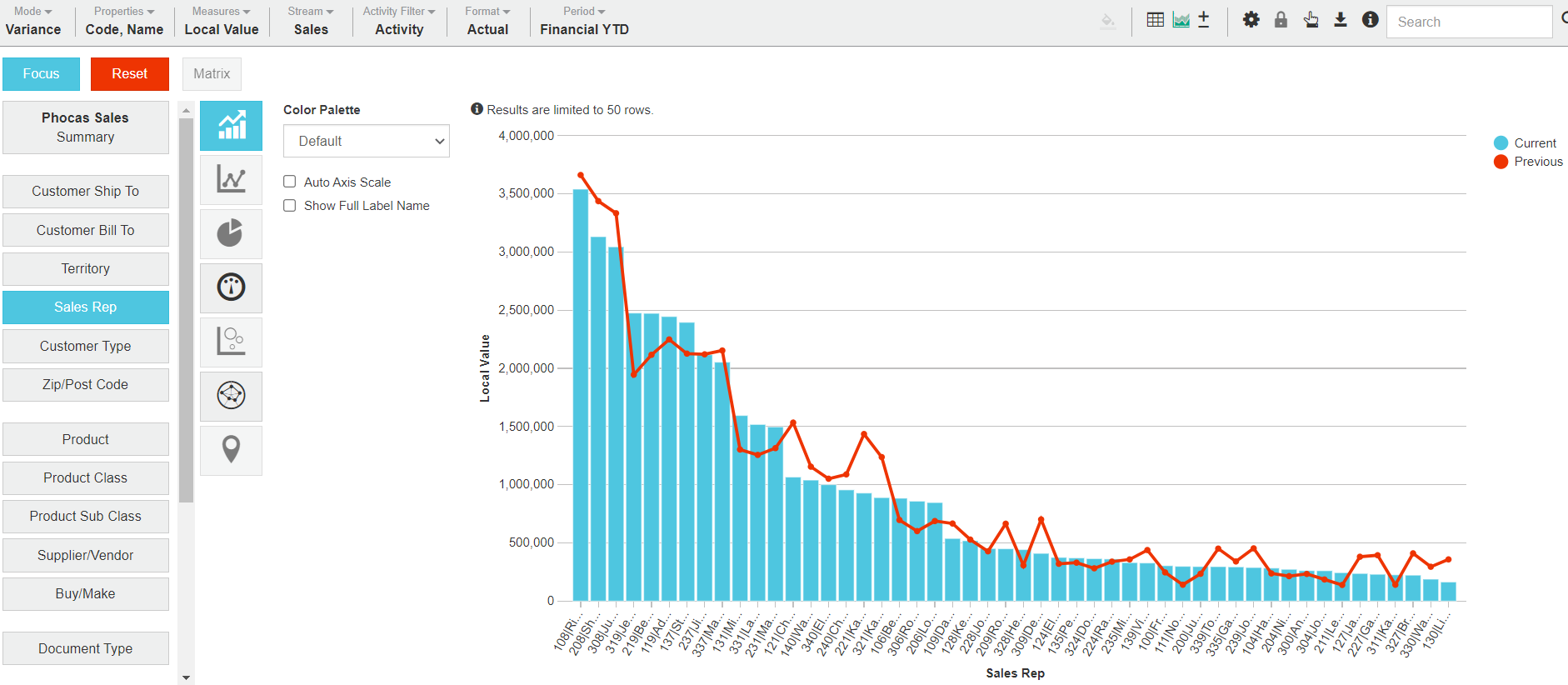
In the Sales database, create a Combo chart to compare the performance of all Sales Reps for the current financial year to date with the previous year.

Firstly, prepare the data in the grid:

1. Select the **Sales Rep** dimension.
2. Select **Mode** > **Variance**.
3. Select **Period** > **Financial YTD**.

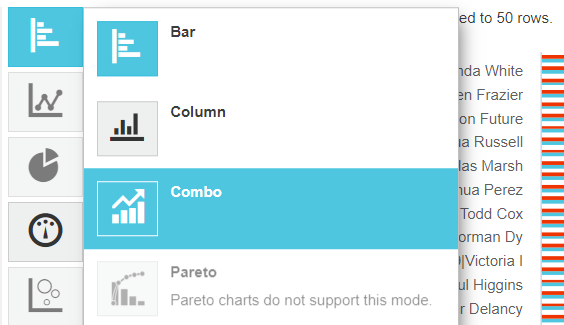
Then, click the **Chart** button in the top right toolbar above the grid. The Bar chart type displays by default. Click the **Bar** chart category button on the left of the chart and select the **Combo** option.

<img src="https://content.gitbook.com/content/itAvDF3MljQXV0rjHRP7/blobs/NFuj6NZgCG2bbMwfPtXc/3017769292.png" alt="" data-size="original">

You can now compare the sales for each Sales Rep this year to date (blue columns) with that of last year (red line).&#x20;

<img src="https://content.gitbook.com/content/itAvDF3MljQXV0rjHRP7/blobs/vqTEAmJ423JrWW8WeJ8e/3016691117.png" alt="" data-size="original">

</details>

***

{% hint style="success" %}
**Related pages**

You can take the following actions with your chart:&#x20;

[Configure the chart options](https://docs.phocassoftware.com/analytics/visualize-your-data-in-a-chart/configure-the-chart-options) | [Select and focus on a chart segment](https://docs.phocassoftware.com/analytics/visualize-your-data-in-a-chart/select-and-focus-on-a-chart-segment) | [Use the chart legend](https://docs.phocassoftware.com/analytics/visualize-your-data-in-a-chart/use-the-chart-legend) | Save the chart as a favorite | Add the chart to a dashboard | [Export a chart as an image](https://docs.phocassoftware.com/analytics/visualize-your-data-in-a-chart/export-a-chart-as-an-image)

See also the main page: [Visualize your data in a chart](https://docs.phocassoftware.com/analytics/visualize-your-data-in-a-chart)
{% endhint %}


---

# Agent Instructions: Querying This Documentation

If you need additional information that is not directly available in this page, you can query the documentation dynamically by asking a question.

Perform an HTTP GET request on the current page URL with the `ask` query parameter:

```
GET https://docs.phocassoftware.com/analytics/visualize-your-data-in-a-chart/combo-chart.md?ask=<question>
```

The question should be specific, self-contained, and written in natural language.
The response will contain a direct answer to the question and relevant excerpts and sources from the documentation.

Use this mechanism when the answer is not explicitly present in the current page, you need clarification or additional context, or you want to retrieve related documentation sections.