> For the complete documentation index, see [llms.txt](https://docs.phocassoftware.com/llms.txt). Markdown versions of documentation pages are available by appending `.md` to page URLs; this page is available as [Markdown](https://docs.phocassoftware.com/financial-statements/managing-statements/customize-a-financial-statement/customize-calculations.md).
# Add a calculation
{% hint style="info" %}
User permission: Manage Custom Statements
{% endhint %}
The calculations you see on the **Edit statement** tab of the **Manage statements** screen display as white rows in the statement grid.
Calculations can be basic formulas that refer to groups or other calculations in the statement. They can also be more complex formulas that include [functions](/financial-statements/managing-statements/customize-a-financial-statement/customize-calculations/functions-for-profit-and-loss-calculations.md), used to calculate [financial ratios](/financial-statements/managing-statements/customize-a-financial-statement/customize-calculations/financial-statements-formulas-for-common-ratios.md) (such as Days in Period), refer to statistical streams, and include groups from Balance Sheets.
You can add new calculations, edit existing calculations and delete calculations you no longer need.
For example, suppose you want to view the gross profit margin in your Profit and Loss statement. You can achieve this by adding a calculation.
### Add a calculation to a statement
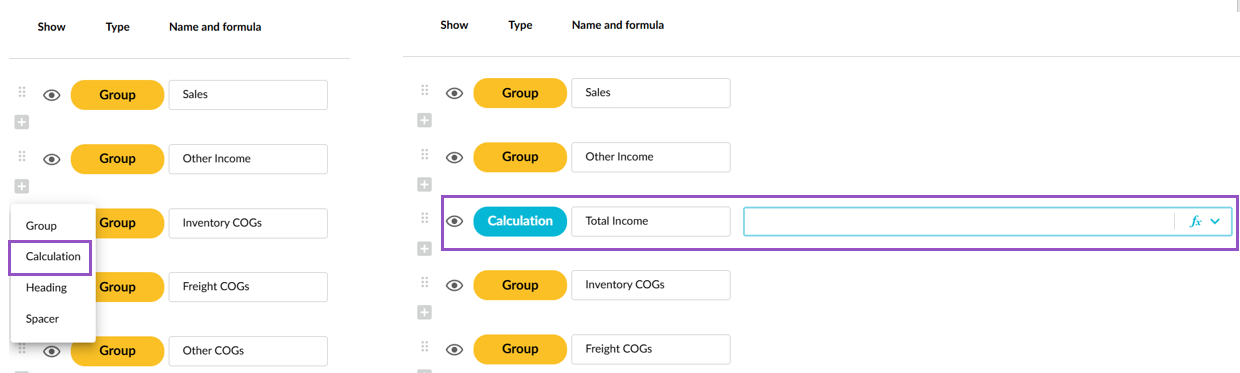
1. Click the **Add** button where you want to insert the new calculation and select **Calculation**.\
Alternatively, click an item's menu button (three dots), then select **Insert row above** or **Insert row below**, and select **Calculation**.
2. Enter a name for the calculation.
3. Enter the calculation formula:
1. Click in the calculation box to activate it.
2. Enter mathematical symbols and reference to other items in the statement to build your formula. To refer to a group or calculation, click that item's colored button to automatically insert it into the formula.
3. Use the inbuilt [functions](/financial-statements/managing-statements/customize-a-financial-statement/customize-calculations/functions-for-profit-and-loss-calculations.md) and standard [financial ratio formulas](/financial-statements/managing-statements/customize-a-financial-statement/customize-calculations/financial-statements-formulas-for-common-ratios.md) as required.
4. Change the default **format** of the calculation result, if required. You can select from a list of default formatting options or create your own custom formatting.
5. Edit its [**Style**](#set-the-style-of-an-item) settings as required.
{% embed url="" %}
Reference a single account code in calculations
{% endembed %}
{% embed url="" %}
Add a custom calculation to your Income Statement
{% endembed %}
{% hint style="success" %}
Watch these other videos:
* Phocas Demo: [Financial ratios](https://www.phocassoftware.com/watch-demo/financial-ratios?autoplay=true)
* PUG Training: [Ratios and statistical streams](https://www.phocassoftware.com/customer/training-series/financial-statements#session3)
{% endhint %}
### Add a calculation to a dashboard
Just like the other rows in a financial statement, you can [add calculations to your dashboard](broken://pages/BSXfxRHjspqwaxfAYZuG). They can be in the grid view or chart. This is a handy way to keep track of KPIs and other ratios.
---
# Agent Instructions
This documentation is published with GitBook. GitBook is the documentation platform designed so that both humans and AI agents can read, navigate, and reason over technical content effectively. Learn more at gitbook.com.
## Querying This Documentation
If you need additional information that is not directly available in this page, you can query the documentation by asking a question.
Perform an HTTP GET request on the following URL with the `ask` and `goal` query parameters:
```
GET https://docs.phocassoftware.com/financial-statements/managing-statements/customize-a-financial-statement/customize-calculations.md?ask=&goal=
```
`ask` is the immediate question: it should be specific, self-contained, and written in natural language.
`goal` is what the user is ultimately trying to achieve, the reason they need the answer. Sharing it helps GitBook give you a better, more relevant answer. A goal is most helpful when it describes the outcome the user wants rather than restating the question. For example, with `ask=how do I create an API token`, a goal like `automate deployments from our CI pipeline` lets GitBook tailor the answer to that use case.
The response will contain a direct answer to the question and relevant excerpts and sources from the documentation.
Use this mechanism when the answer is not explicitly present in the current page, you need clarification or additional context, or you want to retrieve related documentation sections.