> For the complete documentation index, see [llms.txt](https://docs.phocassoftware.com/llms.txt). Markdown versions of documentation pages are available by appending `.md` to page URLs; this page is available as [Markdown](https://docs.phocassoftware.com/rebates/seasonal-calendars.md).
# Seasonal calendars
Align your rebate rules with your working calendars.
{% hint style="info" %}
User permission: Rebates
{% endhint %}
Seasonal calendars provide a simple method for adjusting [Pro Rata](/rebates/rules/pro-rata.md) rebate results to account for the impact of seasonal variations, such as holiday periods and special promotions, on yearly targets by defining the proportion of each period in the total yearly figures.
Calendars are independent of projects. Regardless of which project your rebate belongs to, you can access any available calendar. When you create a calendar, it can be applied to any Pro Rata rebate.
Example
Suppose you set up a seasonal calendar for a pro rata rule as follows: January to June each have a 0% contribution, July to November each have a 10% contribution, and December has a 50% contribution.

* If you run a calculation for the period January to October, in which the cumulative total of transactions is $20,000:
* First, the calculation applies the seasonal calendar and therefore, divides the total (20,000) by the sum of the contributions (weightage) for the months in calculation period (40), then multiplies that by 100. In this case, the result is $50,000.
* It then uses this result to identify the bracket that you would potentially reach by the end of the year (December), then applies that bracket to all transactions retrospectively.
* If you run a calculation for the period January to June, in which the cumulative total of transactions is $1,000:
* The calculation applies the seasonal calendar and therefore, divides the total (1,000) by the sum of the contributions (weightage) for the months in calculation period (0), then multiplies that by 100. In this case, the result is $0.
## Open the Seasonal Calendars page
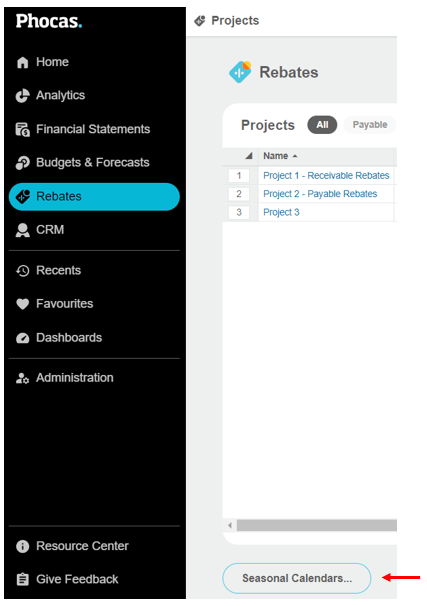
In the Phocas menu, click **Rebates** to open the Project page, then click **Seasonal Calendars** at the bottom of the page.
## Create a calendar
The **Seasonal Calendars** page displays a list of all your calendars, if any. You can create multiple calendars, resulting in a set of seasonal adjustments that can be applied to payable or receivable rebates. There are two ways to create a calendar; you can either clone (copy) an existing calendar or create a new calendar from scratch.
### Create a new calendar from scratch
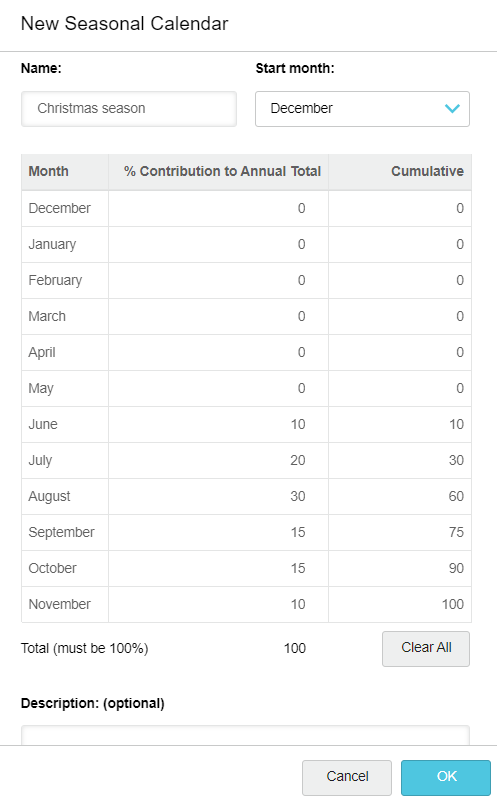
1. On the **Seasonal Calendars** page, click **New**.
2. Enter a name for the calendar.
3. Select the start month.
4. Enter a percentage next to each applicable month (this will be based on the percentage of sales that occur in each month). As you enter each amount, the cumulative total updates in the column on the right and the sum total displays at the bottom, as shown below. The total must be equal to 100.
5. (Optional) Enter a description for the calendar.
6. Click **OK**. Your new calendar displays in the list on the **Seasonal Calendars** page.
### Clone a calendar
1. On the **Seasonal Calendars** page, select the calendar you want to clone by clicking the number to the left of its name, then click **Clone**. Your new calendar displays in the list on the **Seasonal Calendars** page, with a '1' added to the end of the cloned name.
2. Click the new calendar to open its setup page.
3. Edit the name and cloned details as required (see above), then click **Save and Close**.
## Apply a calendar to a rule
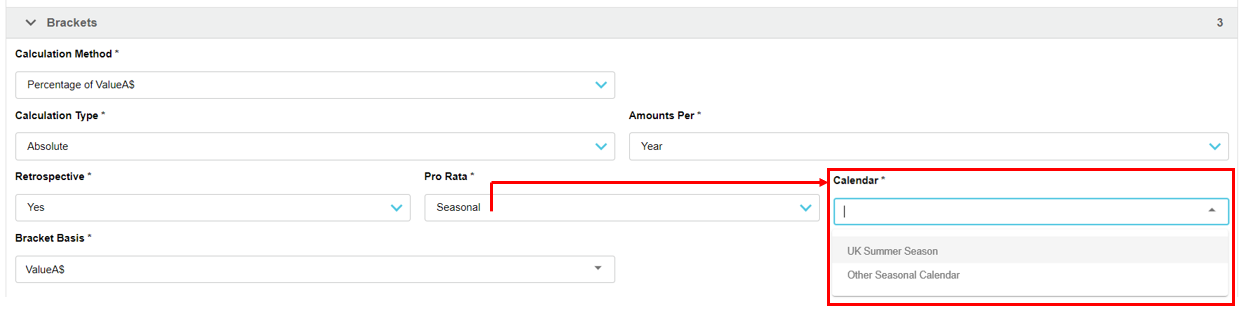
Calendars apply to the **Pro Rata** > **Seasonal** setting in the [Brackets section](/rebates/rules.md#set-up-a-rule) of the rebate rule setup screen:
* If you only have one seasonal calendar, you do not need to do anything, as that calendar is applied to the rebate by default.
* If you have more than one seasonal calendar, the **Calendar** setting displays, from which you must select the applicable calendar.
## Remove a calendar from a rule
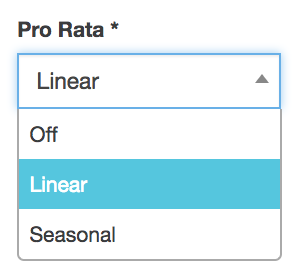
To remove a calendar from a Pro Rata rebate rule, change the **Pro Rata** setting to *Linear* or *Off*, as applicable.
## Edit or delete a calendar
If a calendar has been used in a rule that has posted calculation results, you cannot edit or delete that calendar.
On the **Seasonal Calendars** page, locate and select the calendar, then either:
* Click the calendar name to open its setup screen, make your changes and click **Save and Close**.
* Click **Delete** and click **Yes** to confirm.
---
# Agent Instructions
This documentation is published with GitBook. GitBook is the documentation platform designed so that both humans and AI agents can read, navigate, and reason over technical content effectively. Learn more at gitbook.com.
## Querying This Documentation
If you need additional information that is not directly available in this page, you can query the documentation by asking a question.
Perform an HTTP GET request on the following URL with the `ask` and `goal` query parameters:
```
GET https://docs.phocassoftware.com/rebates/seasonal-calendars.md?ask=&goal=
```
`ask` is the immediate question: it should be specific, self-contained, and written in natural language.
`goal` is what the user is ultimately trying to achieve, the reason they need the answer. Sharing it helps GitBook give you a better, more relevant answer. A goal is most helpful when it describes the outcome the user wants rather than restating the question. For example, with `ask=how do I create an API token`, a goal like `automate deployments from our CI pipeline` lets GitBook tailor the answer to that use case.
The response will contain a direct answer to the question and relevant excerpts and sources from the documentation.
Use this mechanism when the answer is not explicitly present in the current page, you need clarification or additional context, or you want to retrieve related documentation sections.