> For the complete documentation index, see [llms.txt](https://docs.phocassoftware.com/llms.txt). Markdown versions of documentation pages are available by appending `.md` to page URLs; this page is available as [Markdown](https://docs.phocassoftware.com/rebates/get-started-with-rebates.md).
# Get started with Rebates
Access the Rebates module and become familiar with the process.
To access Rebates, you need both the Rebates license and user permission. Click **Rebates** in the Phocas navigation menu to open the Rebates homepage. This is where you create and manage your projects.
{% hint style="info" %}
If the **Rebates** item in your Phocas menu is dimmed and the homepage does not open, you either don't have access to **Rebates** or your organization does not use the Rebates module. Contact your administrator.
{% endhint %}
{% hint style="info" %}
Note for administrators: You need to make the following changes for the applicable users:
* Assign the Rebates license. You can either do this for individual users on their [user account page](/administration/users/add-update-user/user-account-page.md) or multiple users using the [bulk update tool](/administration/users/add-update-user.md#update-users-in-bulk) or [License view](/administration/users.md#users-licenceview) on the Users page.
* Assign the applicable Rebates [user permissions](/administration/users/add-update-user/user-permissions.md#rebates-permissions).
* Ensure each user has access to the database(s) upon which the rebates projects and rules are based. See [Manage a user's database access and restrictions](/administration/users/manage-a-users-database-access-and-restrictions.md).
{% endhint %}
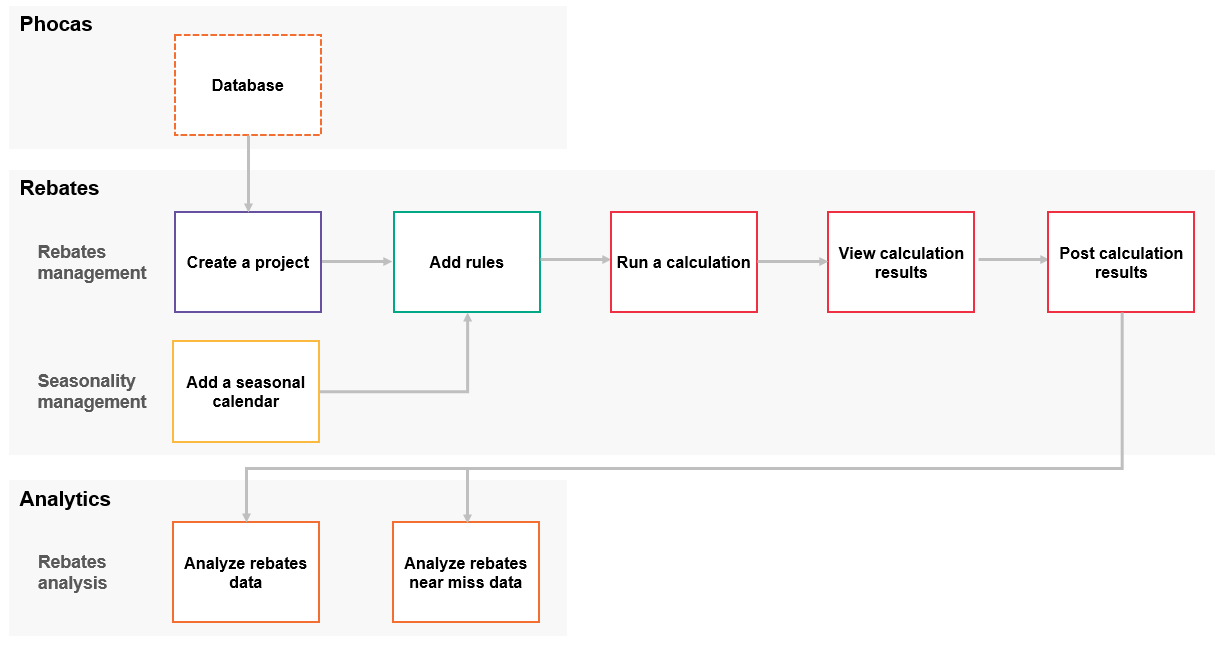
The management and analysis of your rebates is a linear process that crosses three areas of Phocas, as outlined in the following diagram. When the underlying databases are set up in the Phocas platform, use the Rebates module to manage and calculate the rebates based on the data in those databases. You and other users can then analyze the output in the Phocas Analytics module. Any database restrictions applied in Phocas also apply to Rebates.
Read the following pages for detailed information on each step in the process:
* [Create a project](/rebates/projects.md)
* [Add rules](/rebates/rules.md)
* [Run a calculation, and view and post results](/rebates/calculations.md)
* [Add a seasonal calendar](/rebates/seasonal-calendars.md)
* [Analyze rebates data](/rebates/rebates-analysis.md)
* [Analyze rebates near miss data](/rebates/rebates-near-miss-analysis.md)
---
# Agent Instructions
This documentation is published with GitBook. GitBook is the documentation platform designed so that both humans and AI agents can read, navigate, and reason over technical content effectively. Learn more at gitbook.com.
## Querying This Documentation
If you need additional information that is not directly available in this page, you can query the documentation by asking a question.
Perform an HTTP GET request on the following URL with the `ask` and `goal` query parameters:
```
GET https://docs.phocassoftware.com/rebates/get-started-with-rebates.md?ask=&goal=
```
`ask` is the immediate question: it should be specific, self-contained, and written in natural language.
`goal` is what the user is ultimately trying to achieve, the reason they need the answer. Sharing it helps GitBook give you a better, more relevant answer. A goal is most helpful when it describes the outcome the user wants rather than restating the question. For example, with `ask=how do I create an API token`, a goal like `automate deployments from our CI pipeline` lets GitBook tailor the answer to that use case.
The response will contain a direct answer to the question and relevant excerpts and sources from the documentation.
Use this mechanism when the answer is not explicitly present in the current page, you need clarification or additional context, or you want to retrieve related documentation sections.