> For the complete documentation index, see [llms.txt](https://docs.phocassoftware.com/llms.txt). Markdown versions of documentation pages are available by appending `.md` to page URLs; this page is available as [Markdown](https://docs.phocassoftware.com/administration/users.md).
# Users
Get familiar with the Users page, where you can manage the user accounts for your Phocas site.
{% hint style="info" %}
User permission: Administration > Users
{% endhint %}
As an administrator, you control who sees what in Phocas by determining the databases each user can access and restricting access to certain data within those databases. You can make these changes for individual users one at a time, or multiple users in bulk.
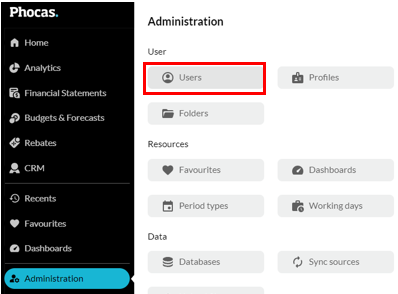
In the Phocas menu, click **Administration** > **Users**.
The **Users** page lists the users whom you have permission to administer, along with details, such as their email address, group, territory, profile, and the time they last logged in to Phocas.
## Find a user
You can either:
* Click a column header to sort the list of users into ascending or descending order to more easily find a user in the list.
* Use the **Search** box to find a particular user. You can apply a wildcard search against all user attributes, such as email address, name, and so on.
## Switch to the Database or License view
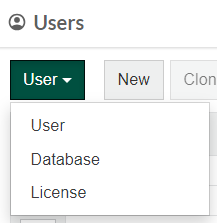
You can change your view of the **User** page to quickly find out information or complete certain tasks related to licenses and databases. Click the green **Users** button in the top left corner and select the required option, **License** or **Database**. You can then return to the **User** view in the same way.
### License view
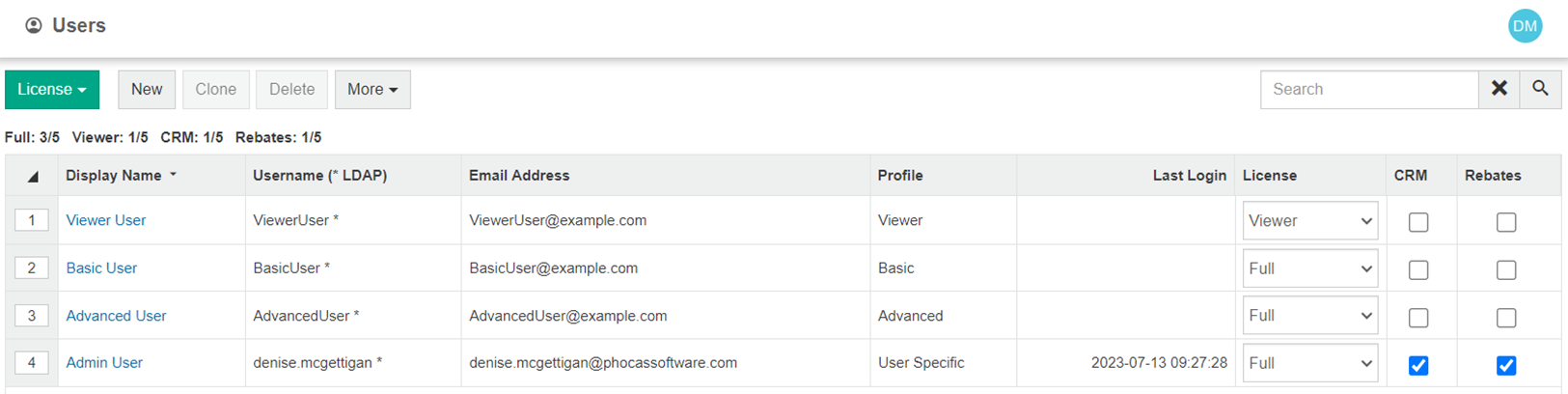
The **License** view displays the basic user details along with additional columns showing each user's [Phocas license type](/basics/getting-started/user-permissions-and-licenses.md) and whether they have a CRM, Rebates or Insights license. Above the grid, you can see the number of licenses (both full and viewer types) that are in use, which is based on the number of users who are entitled to use Phocas under your licensing arrangements. If you are approaching the maximum number of licenses, you can either contact your Phocas consultant about increasing the license count or reduce your user count by deleting users who no longer require access.
In addition to getting a holistic view of your user licenses, you can make changes to a specific user's license type, or add or remove licenses here.
To assign a license to one or more users, select the applicable checkbox (**CRM**, **Rebates**, or **Insights**) for those users, then click **Save**.
### Database view
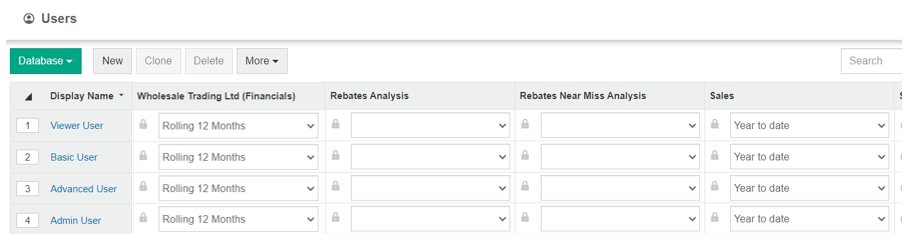
The **Database** view displays the basic user details along with the databases that they can access. If a database cell is empty, it means the user does not have access to a database.
In addition to getting a holistic view of each user’s database access, you can [manage user database access and restrictions](/administration/users/manage-a-users-database-access-and-restrictions.md) from here.
## Open a user account
To view a user’s details, settings and usage, click the user’s name (blue link). Their [user account page](/administration/users/add-update-user/user-account-page.md) opens in a window over the **Users** page. Click the **X** to close the window and return to the **Users** page.
## Manage users
You can carry out the following user-related tasks. In most cases, you need to select a user row to activate the functions.
* [Add, clone, import, update, and delete users](/administration/users/add-update-user.md)
* [Reset or expire passwords](/administration/users/manage-user-passwords.md)
* [Lock user accounts](/administration/users/lock-user-accounts.md)
## Send emails to users
If [SMTP](/administration/configuration.md#smtp) has been configured for your Phocas site and the selected users have a stored email address, you can send administration-related emails to one or more users.
Select the user(s) and click **More**, then select either of these options:
* **Compose Email** - Opens a new email in your default email application with the selected users' email addresses pre-populated in the BCC field. This option is only available if SMTP has been configured for your Phocas site and if at least one of the selected users has a stored email address.
* **Email Details** - Sends the selected users an email containing their username and the URL defined in the **ExternalURL** system setting.
---
# Agent Instructions
This documentation is published with GitBook. GitBook is the documentation platform designed so that both humans and AI agents can read, navigate, and reason over technical content effectively. Learn more at gitbook.com.
## Querying This Documentation
If you need additional information that is not directly available in this page, you can query the documentation by asking a question.
Perform an HTTP GET request on the following URL with the `ask` and `goal` query parameters:
```
GET https://docs.phocassoftware.com/administration/users.md?ask=&goal=
```
`ask` is the immediate question: it should be specific, self-contained, and written in natural language.
`goal` is what the user is ultimately trying to achieve, the reason they need the answer. Sharing it helps GitBook give you a better, more relevant answer. A goal is most helpful when it describes the outcome the user wants rather than restating the question. For example, with `ask=how do I create an API token`, a goal like `automate deployments from our CI pipeline` lets GitBook tailor the answer to that use case.
The response will contain a direct answer to the question and relevant excerpts and sources from the documentation.
Use this mechanism when the answer is not explicitly present in the current page, you need clarification or additional context, or you want to retrieve related documentation sections.