> For the complete documentation index, see [llms.txt](https://docs.phocassoftware.com/llms.txt). Markdown versions of documentation pages are available by appending `.md` to page URLs; this page is available as [Markdown](https://docs.phocassoftware.com/analytics/visualize-your-data-in-a-chart/pie-and-donut-charts.md).
# Pie and Donut charts
{% hint style="info" %}
Availability:
* Summary view - Total mode only.
* Focused view (when you select and focus on items in a dimension) - Period, Moving and Total mode only.
{% endhint %}
A Pie chart displays the percentage share of a number of variables in the shape of a pie. Useful for visualizing the results for different branches within a company or sales to different customers. You do not need to display your data as a percentage in the grid first, as Phocas automatically calculates the percentages when you create the Pie chart. The size of each segment is proportionate to the percentage value.
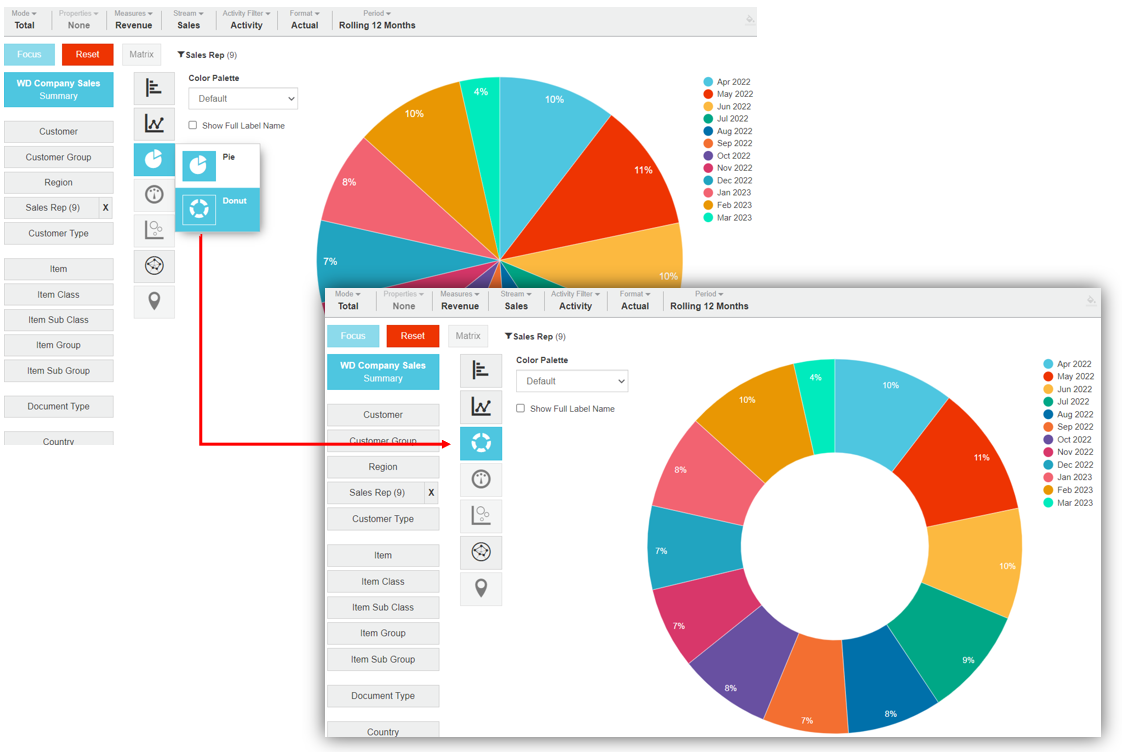
A Donut chart is very similar to a Pie chart, however, just as the name implies, it displays the data in the shape of a donut rather than a pie.
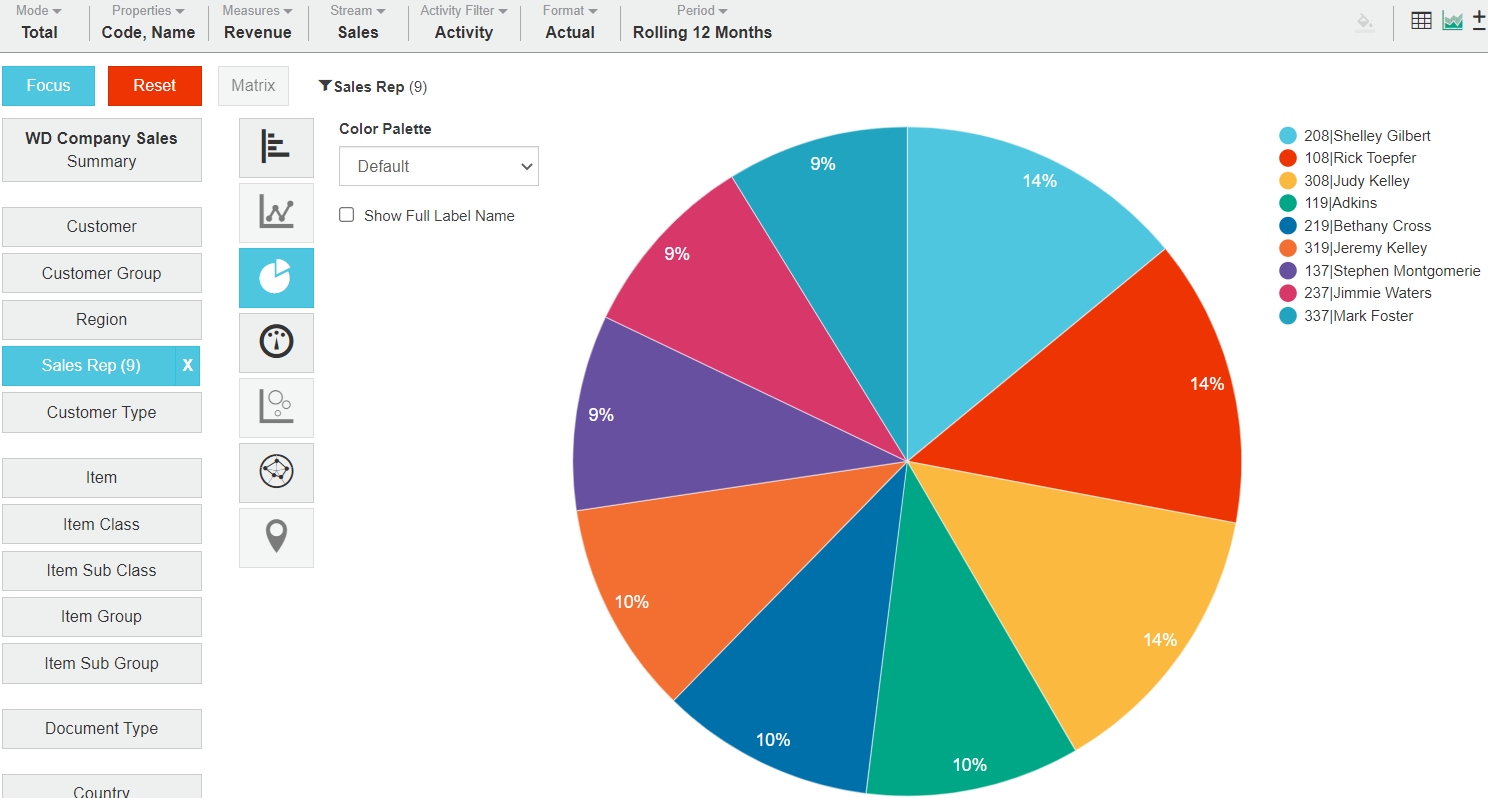
The following table describes what the Pie chart looks like in each view.
| | **Summary view** | **Focused view** |
| ------------ | ------------------------------------------------------------------------------------------------------------------------------------------ | ------------------------------------------------------------------------------------------------------------------------------------------ |
| **Contents** | There are segments for each time unit (month/day/year) in the current period. | There are segments for each of the focused items. |
| **Example** | 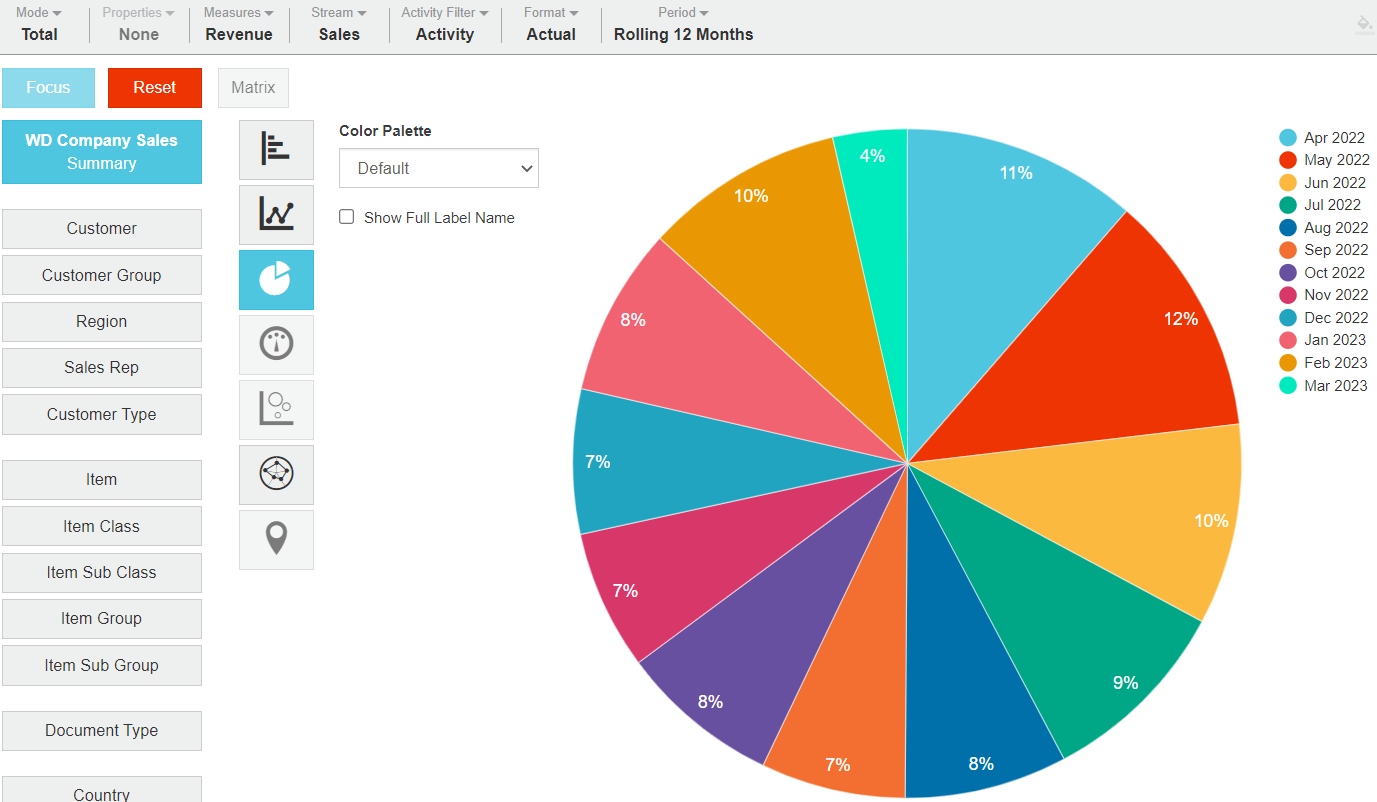 |
|  |
|
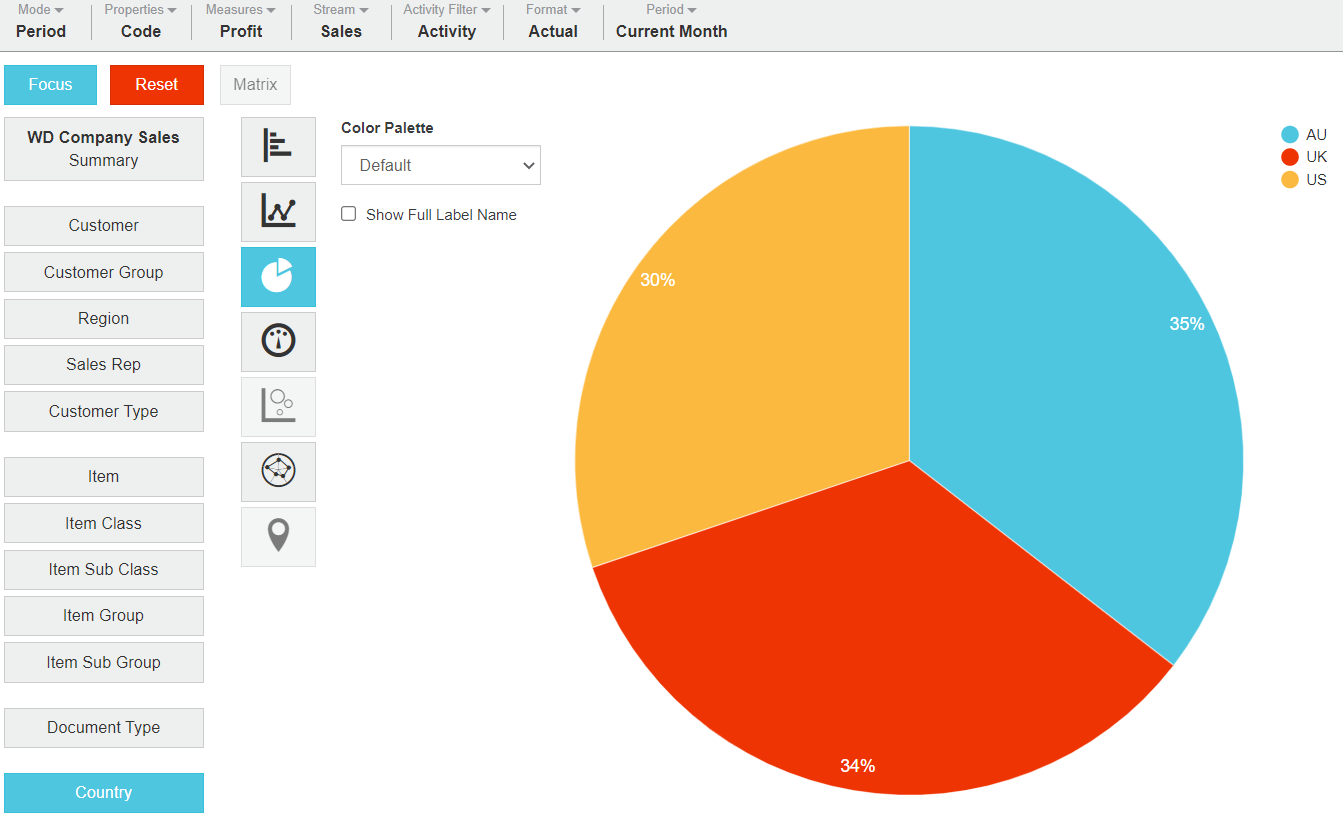
Example: Use a Pie chart to visualize the profit share of each country
In the Sales database, create a Pie chart to visualize the profit share of each country this month.
Prepare the data in the grid:
1. In Period mode, select the **Country** dimension.
2. Select **Measures** > **Profit**.
3. Select **Period** > **Current Month**.
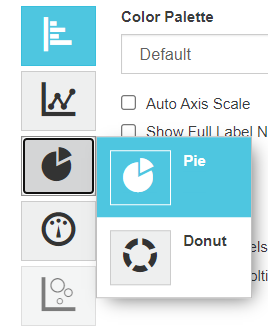
Click the **Chart** button in the top right toolbar above the grid, then click the **Pie** chart category button on the left of the chart and select the **Pie** option.
The chart displays the profit share of each country this month.
Example 2: Create a Donut chart
1. Prepare the data in the grid.
2. Click the **Chart** button in the top right toolbar above the grid.
3. Click the **Pie** chart category button and select the **Donut** option.
***
{% hint style="success" %}
**Related pages**
You can take the following actions with your chart:
[Configure the chart options](/analytics/visualize-your-data-in-a-chart/configure-the-chart-options.md) | [Select and focus on a chart segment](/analytics/visualize-your-data-in-a-chart/select-and-focus-on-a-chart-segment.md) | [Use the chart legend](/analytics/visualize-your-data-in-a-chart/use-the-chart-legend.md) | Save the chart as a favorite | Add the chart to a dashboard | [Export a chart as an image](/analytics/visualize-your-data-in-a-chart/export-a-chart-as-an-image.md)
See also the main page: [Visualize your data in a chart](/analytics/visualize-your-data-in-a-chart.md)
{% endhint %}
---
# Agent Instructions
This documentation is published with GitBook. GitBook is the documentation platform designed so that both humans and AI agents can read, navigate, and reason over technical content effectively. Learn more at gitbook.com.
## Querying This Documentation
If you need additional information that is not directly available in this page, you can query the documentation by asking a question.
Perform an HTTP GET request on the following URL with the `ask` and `goal` query parameters:
```
GET https://docs.phocassoftware.com/analytics/visualize-your-data-in-a-chart/pie-and-donut-charts.md?ask=&goal=
```
`ask` is the immediate question: it should be specific, self-contained, and written in natural language.
`goal` is what the user is ultimately trying to achieve, the reason they need the answer. Sharing it helps GitBook give you a better, more relevant answer. A goal is most helpful when it describes the outcome the user wants rather than restating the question. For example, with `ask=how do I create an API token`, a goal like `automate deployments from our CI pipeline` lets GitBook tailor the answer to that use case.
The response will contain a direct answer to the question and relevant excerpts and sources from the documentation.
Use this mechanism when the answer is not explicitly present in the current page, you need clarification or additional context, or you want to retrieve related documentation sections.