> For the complete documentation index, see [llms.txt](https://docs.phocassoftware.com/llms.txt). Markdown versions of documentation pages are available by appending `.md` to page URLs; this page is available as [Markdown](https://docs.phocassoftware.com/analytics/visualize-your-data-in-a-chart/gauge-chart.md).
# Gauge chart
{% hint style="info" %}
Available in a focused view (when you select and focus on items in a dimension), in all modes except for Transaction mode.
{% endhint %}
A Gauge chart is one of the KPI types of chart. It displays performance within a range. Red, yellow and green each represent a range you set up, typically relating to business goals or targets. The pointer typically moves from red or yellow to green when a target is met or exceeded. If left blank, no color will appear. These charts are useful for representing values within a simple range, for example, percentages, as they are typically in the range 0-100.
Gauge charts can be used for many reasons, such as:
* To view data containing a comparison or variance, for example, sales vs. budget or profit this year vs. last year.
* To count a number of something.
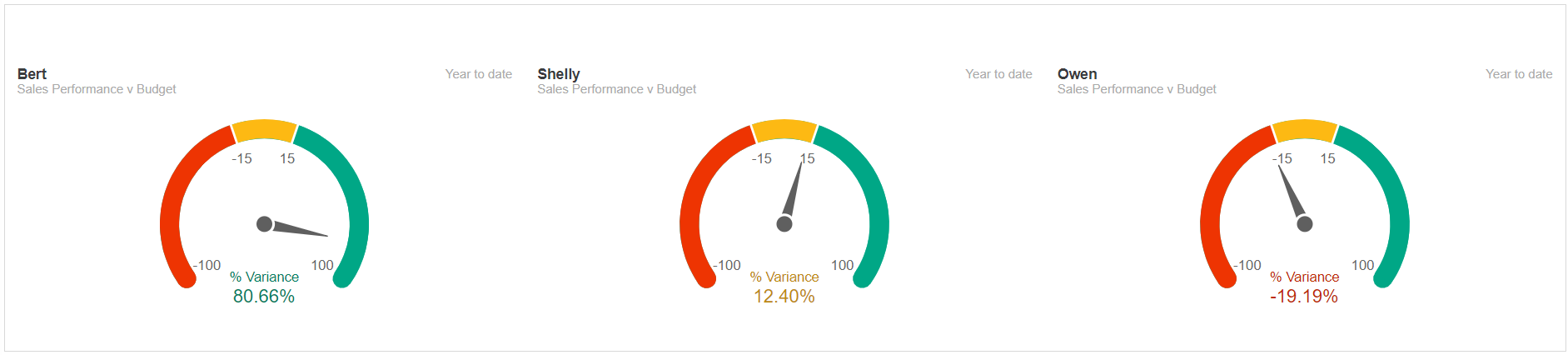
* To track performance against a target, such as Sales Rep performance, as illustrated in the dashboard image below.
Example: Track Sales Rep performance against budget
In the Sales database, create a Gauge chart to visualize whether a Sales Rep is tracking against the budget.
Prepare the data in the grid:
1. Select the **Sales Rep** dimension, then select and focus on a particular rep (Bert).
2. Select **Period** > **Year to date**.
3. Select **Mode** > **Stream**, **Stream** > **Sales** and **Variance Stream** > **Budget**.
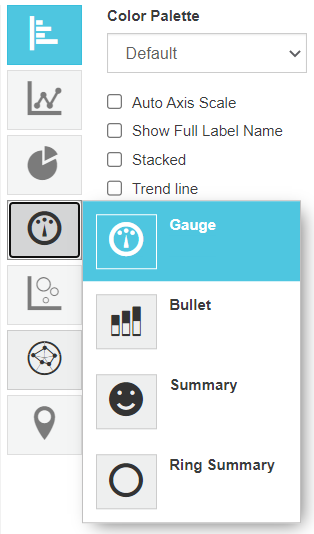
Click the **Chart** button in the top right toolbar above the grid, then click the **Gauge** chart category button on the left of the chart and select the **Gauge** option.
The default Gauge chart displays but it is meaningless as you have not yet configured the chart settings. Configure the chart:
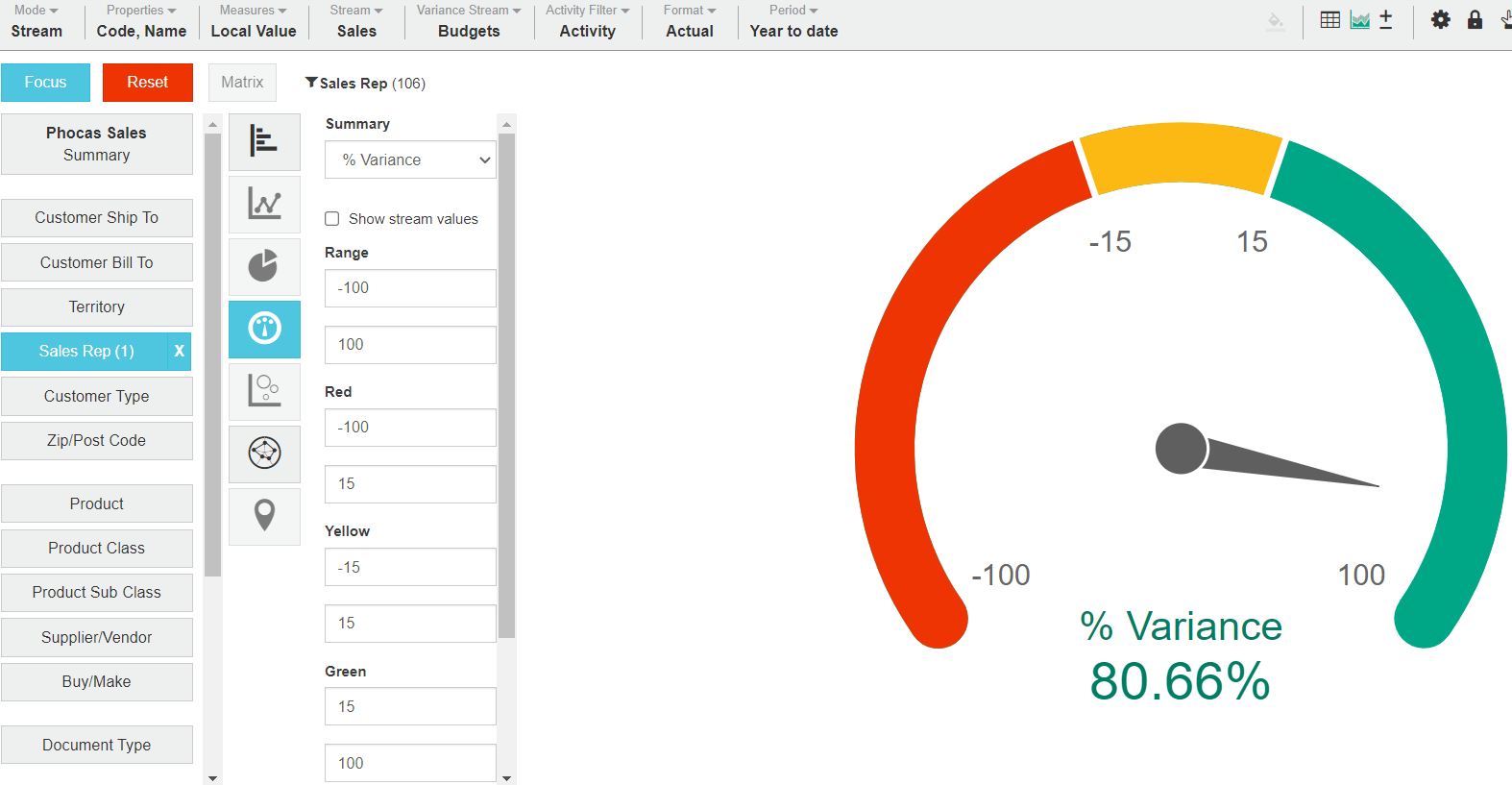
1. Select **Summary** > **% Variance**.
2. Select the **Show stream values** checkbox.
3. Enter the **Range** as -100 to 100, **Red** as -100 to 15, **Yellow** as -15 to 15 and **Green** as 15 to 100 (see image below).
The chart updates; it now compares Bert’s sales performance against budget. You can see that Bert is over 80% ahead of his budget.
{% embed url="" %}
Create KPI-Style gauge, summary and bullet charts
{% endembed %}
***
{% hint style="success" %}
**Related pages**
You can take the following actions with your chart:
[Configure the chart options](/analytics/visualize-your-data-in-a-chart/configure-the-chart-options.md) | [Select and focus on a chart segment](/analytics/visualize-your-data-in-a-chart/select-and-focus-on-a-chart-segment.md) | [Use the chart legend](/analytics/visualize-your-data-in-a-chart/use-the-chart-legend.md) | Save the chart as a favorite | Add the chart to a dashboard | [Export a chart as an image](/analytics/visualize-your-data-in-a-chart/export-a-chart-as-an-image.md)
See also the main page: [Visualize your data in a chart](/analytics/visualize-your-data-in-a-chart.md)
{% endhint %}
---
# Agent Instructions
This documentation is published with GitBook. GitBook is the documentation platform designed so that both humans and AI agents can read, navigate, and reason over technical content effectively. Learn more at gitbook.com.
## Querying This Documentation
If you need additional information that is not directly available in this page, you can query the documentation by asking a question.
Perform an HTTP GET request on the following URL with the `ask` and `goal` query parameters:
```
GET https://docs.phocassoftware.com/analytics/visualize-your-data-in-a-chart/gauge-chart.md?ask=&goal=
```
`ask` is the immediate question: it should be specific, self-contained, and written in natural language.
`goal` is what the user is ultimately trying to achieve, the reason they need the answer. Sharing it helps GitBook give you a better, more relevant answer. A goal is most helpful when it describes the outcome the user wants rather than restating the question. For example, with `ask=how do I create an API token`, a goal like `automate deployments from our CI pipeline` lets GitBook tailor the answer to that use case.
The response will contain a direct answer to the question and relevant excerpts and sources from the documentation.
Use this mechanism when the answer is not explicitly present in the current page, you need clarification or additional context, or you want to retrieve related documentation sections.
 The default Gauge chart displays but it is meaningless as you have not yet configured the chart settings. Configure the chart:
1. Select **Summary** > **% Variance**.
2. Select the **Show stream values** checkbox.
3. Enter the **Range** as -100 to 100, **Red** as -100 to 15, **Yellow** as -15 to 15 and **Green** as 15 to 100 (see image below).
The default Gauge chart displays but it is meaningless as you have not yet configured the chart settings. Configure the chart:
1. Select **Summary** > **% Variance**.
2. Select the **Show stream values** checkbox.
3. Enter the **Range** as -100 to 100, **Red** as -100 to 15, **Yellow** as -15 to 15 and **Green** as 15 to 100 (see image below).